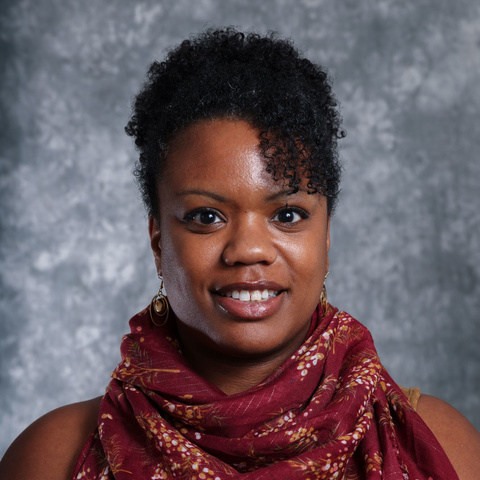
Charisse Madlock-Brown is a self-described puzzler, with a love of discovery and creative problem-solving. Growing up she wanted to be a nun due to their air of mystery and dedication to service, but after working in the library during college she chose to pursue library science instead. Returning to her hometown of Iowa City, Iowa to earn a master’s in library science at the University of Iowa, Madlock-Brown began working at the Hardin Library for Medical Sciences. It was there she discovered a whole new world that combined puzzles, service, and the research, information management, and data analysis skills she was gaining in her master’s program—health informatics. “I found that people in medicine had a lot of interesting questions and many of the tools and technologies weren’t up to speed to answer them. I saw several opportunities to do some interesting problem solving,” she says.
Madlock-Brown worked for the Iowa Clinical and Translational Science Institute and earned her PhD in health informatics from Iowa. Soon after, she joined the faculty of the Department of Health Informatics and Information Management at the University of Tennessee Health Science Center in Memphis, where she stayed until returning to Iowa and joining the College of Nursing in 2023.
As electronic health records (EHR) have become the norm, enterprise data warehouses have grown alongside them to house and integrate data from entire health systems. A large part of the work Madlock-Brown does involves making this data research-ready and exploring the capabilities of the vast data sets.
She works with both local and national databases, like the National Clinical Cohort Collaborative (N3C). The N3C collects EHR data from more than 90 institutions and harmonizes it into a single common data model for consistency. It also connects data from other sources, like kidney registries, to give researchers a more complete view of patient health across systems and communities. “The N3C is a repository of patient level EHR data for over 70 million patients across the entire country, so the kind of analyses we can do is very unique,” says Madlock-Brown. She also notes that these types of repositories are useful for studying not just health but health care and how patients interact with health systems.
N3C was initially developed to speed up research in response to the COVID-19 pandemic and has now expanded to host cohorts for other diseases, including cancer and renal disease. Madlock-Brown is the co-lead of an N3C team and directs research on social determinants of health and COVID-19 outcomes. In January 2024, she appeared before the U.S. Senate Committee on Health, Education, Labor and Pensions at a hearing on long COVID research and patient care, testifying to the benefits of using N3C EHR data. “…[T]hrough the strategic use of large EHR warehouse networks, research into long COVID and similar complex health conditions can become more accurate, inclusive, and representative, leading to more effective and personalized healthcare solutions,” she told the committee.
Madlock-Brown also serves as a multiple principal investigator for the Center for Linkage and Acquisition of Data, a core component of the All of Us research program. The All of Us initiative aims to build a diverse database with more than one-million participants, which can inform studies on a variety of health conditions. Leading the center’s geospatial team, Madlock-Brown is integrating environmental, community, and other area-level datasets into existing EHR and survey data to further research opportunities and potential discoveries. "This work enables longitudinal, place-based analyses that capture how environmental and social contexts shape health across the life course,” she explains.
Although she is only interacting with their medical records, Madlock-Brown is passionate about the people behind the EHR data, and that’s why she has found a home in the College of Nursing. “Nurse researchers get it,” she says. It’s not just about methods and diseases, but about patient populations and symptoms; it’s about recognizing multimorbidity as more than just the sum of the co-morbidities. At the college, she appreciates the mix of clinical and research expertise, and the emphasis on team projects. She also enjoys seeing the passion in the Doctor of Nursing Practice students as she helps them with their research questions and methods, and knowing the impact they will make on healthcare in the future.
Read more from the Winter 2025/26 Newsletter