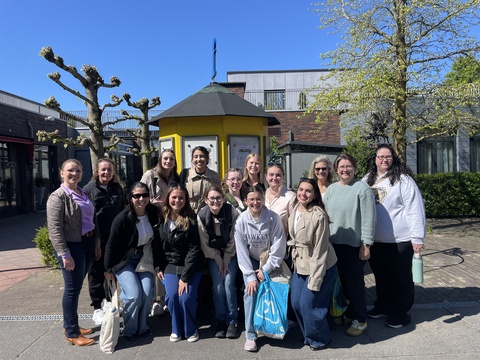
A few years ago, during a meeting of the College of Nursing Transcultural Special Interest Group, the idea arose to take a group of undergraduate students to the Netherlands. This spring, that idea became a reality when eight BSN students, four RN-BSN students, and two faculty spent ten days learning how a country regarded as a global leader in aging policy and support for active aging, age-friendly environments, and aging in place cares for older adults. Developed and led by CON faculty Emily Griffin, Betty Mallen, and Shalome Tonelli, this study abroad experience is unlike anything else the college offers. It brings together students from different CON programs, who are in different classes and at different points in their nursing careers, for a shared immersive experience.
To prepare for the trip, Mallen’s RN-BSN Community and Public Health Practicum students spent half of their practicum hours researching the Dutch healthcare system, researching long-term care, and doing comparisons with the US health system. Tonelli’s pre-licensure gerontology practicum students, since they were new to clinical practice, spent 40-50 clinical hours in a long-term care setting before the trip to gain experience with the older adult care system in the US.
While in the Netherlands, the students visited innovative sites like the Hogeweyk Dementia Village, where residents with dementia live together in small households in a neighborhood environment. They also talked with health care experts about topics like end-of-life care, as euthanasia is legal in the country.
“It was an amazing opportunity to learn about how care for older adults differed between the two countries,” says BSN student Nyah Lopez. “Being able to see places such as the Hogeweyk and interact with Dutch health professionals taught me so much about the value of independence in that phase of life.”
Not all of Mallen’s RN-BSN students on the trip worked in long-term care, but much of it was applicable to the older adults they take care of, she says. “They made comments many times after we visited a place, saying ‘I could do this with my patients’.”
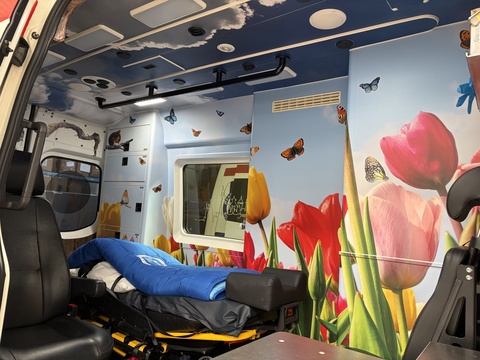
One visit the students particularly enjoyed was to the Wish Ambulance Foundation, a nationwide network with custom ambulances that help patients who are near the end of life and no longer mobile fulfill a last wish. The organization has over 350 volunteers, primarily nurses and drivers. “I think the students really liked touring that place and hearing from the volunteers,” says Tonelli. “They were so passionate about what they were doing, and it was really cool to hear how they go about it.”
After returning from the trip, both RN-BSN and BSN students reflected and wrote about their experiences. “In the United States, we often focus heavily on safety restrictions,” one RN-BSN student wrote, “but the Netherlands showed me how balancing safety with autonomy can improve both physical and emotional well-being.”
As the students learn how the Dutch health system works, Tonelli, Mallen, and Griffin hope they are inspired to “take away some of those parts that seem like they could be good improvements to our health system,” says Tonelli. “It’s not just them traveling, it's impacting the care that they can give here.”
This trip was made possible with support from the Kelting Fund in Global Health, the Jo Eland Excellence Fund, and private donations. Another group of BSN and RN-BSN students is preparing to travel to the Netherlands this fall, and the immersive learning experience will continue each fall and spring semester thereafter.