
Linda Gerdner (92MA, 98PhD) was a master’s student doing a practicum at an adult day care center in Cedar Rapids, Iowa, when she met a client named Elsa (not her real name). Elsa was hard to talk to; she was constantly agitated and kept repeating that she wanted to go home. Knowing Elsa had Czech heritage and liked musician Leo Greco, Gerdner brought in his music and played it for Elsa. “We listened to it, and pretty soon she'd be tapping her foot,” Gerdner recalls. “And when we got done, she said ‘that was fun’.”
That interaction with Elsa planted the seed for what would become Gerdner’s lasting contribution to nursing and patient care: the Middle-Range Theory of Individualized Music Intervention for Agitation, and the accompanying Evidence-Based Guideline: Individualized Music for Persons with Dementia. Gerdner has chosen the Csomay Center in the UI College of Nursing as the home for her legacy, to be known as the Linda Gerdner Theory-Guided Evidence-Based Protocol of Individualized Music for Agitation in Persons with Dementia Repository.
The basis of Gerdner’s theory and protocol is individualized music. “Music is processed in a separate portion of the brain from verbal stimuli,” she says. “If you take that into consideration, and the fact that persons with dementia have preserved long term memory for quite some time into the advanced stages [of dementia], it makes sense that music would be an alternative method of trying to calm them down. There's a lot of stimuli in a nursing home coming in at them from all directions; it's all confusing and they don't understand it, so let's have them focus on something that is meaningful to them. Something that brings back positive memories.” The key component is making sure the music is individualized and meaningful to the participant. General music from a ‘relaxing’ genre or of a certain era will not have the same result as a very precise musical selection. “You’ve got to reach the heart and soul of somebody,” Gerdner says.
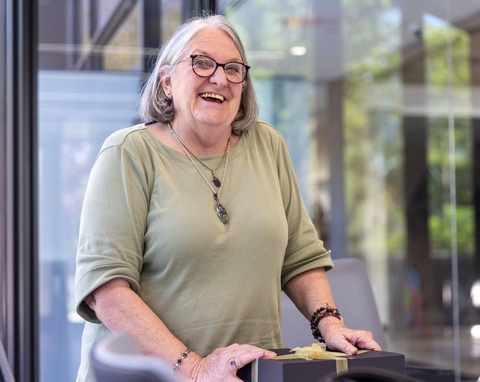
Since publication, Gerdner’s theory and intervention have been tested in a variety of settings by researchers across the globe, providing a body of evidence that supports the use of individualized music for persons with Alzheimer’s disease and related dementias. Gerdner’s evidence-based guideline was originally published in 1997 and is now in its 7th edition. in 2017, Gerdner published a children’s book called “Musical Memories” that is based on the guideline’s principles.
After finishing her PhD, Gerdner went on to work at University of Arkansas for Medical Sciences, University of Minnesota, and Stanford University, but when it came time to create her repository, she returned to where it all began - Iowa. Explaining why she chose the College of Nursing, Gerdner cites the legacy of expertise in gerontology, the meaningful connections she still has here, and her successful experience as a student. When she came to Iowa as a student, “I fit and I loved it,” Gerdner says. “I felt like I was thriving and growing in all different avenues… So, why would I [choose] anywhere else?”
With the creation of the repository, Gerdner hopes future nurses will continue her work, expanding and adapting it as necessary. She sees them using their own creativity and, “following what we’ve got started, but then identifying what works better, and seeing how they can adapt it and bring it into the future.”