
College of Nursing alumna Rene Buenzow (23DNP, 00BSN) never imagined getting involved in legislative policy and politics, but when she moved from Iowa to Wisconsin in 2020, everything changed. Buenzow became actively engaged in the fight to achieve full-practice authority for nurse practitioners (NPs) in Wisconsin, even making it the focus of her Doctor of Nursing Practice (DNP) project. Now a director-at-large on the board of the Wisconsin Nurses Association and a village trustee for the town where she lives, outside Madison, Wisconsin, she proudly credits the UI DNP program for giving her, “the fire in my belly to pursue some of these areas of interest that I don’t think I would have had the courage to pursue had I not been in this program.”
Buenzow began her DNP at UI in 2020, after working as a family nurse practitioner in Iowa for nearly 15 years. After an unexpected move to Wisconsin that same year, she found herself face-to-face with the licensing barriers of a reduced practice state. In Wisconsin, NP practice authority was limited by law, and required physician supervision. Iowa, on the other hand, is one of 27 full-practice states where NPs can practice to the full extent of their licenses. “I reached out to the governor, I reached out to my local representatives,” Buenzow said, “and I joined the Wisconsin Nurses Association (WNA) to start to network.” She learned that nurse practitioners were granted full practice authority under an emergency order during the COVID-19 pandemic but says it didn’t feel authentic. Why were nurse practitioners good enough to fill that role during COVID, but not permanently, she wondered. Determined to help spur change, Buenzow joined the WNA public policy committee and got to work.
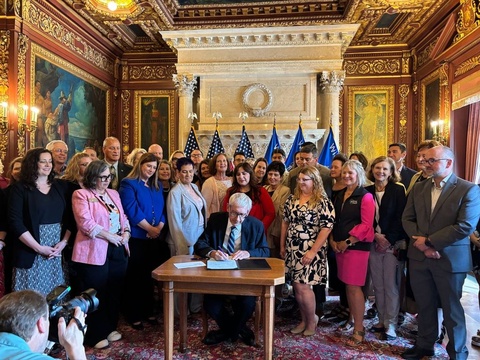
The Advanced Practice Registered Nurse (APRN) Modernization Act, as it is known, made it through the Wisconsin legislature in 2022, only to be vetoed by the governor. He vetoed it again when it landed on his desk in 2024. Undeterred, the act’s proponents tried again the following year and in August 2025 the bill was signed into law. Current experienced nurse practitioners have full practice authority immediately, but others will need to complete 3,840 supervised hours with a physician or dentist. “It was a major leap forward for nurse practitioners.” says Buenzow. “There are still some steps that we need to fine tune over time.”
In the UI DNP program, “we have a history of being very intentional about teaching students the importance of advocacy,” says Dan Crawford (13DNP, 11MSN, 09BSN), associate dean for graduate practice programs and clinical professor. “Not just as a conceptual topic, but the application of it—how do you actually get out and make a difference from an advocacy standpoint.” That teaching extends beyond the required health policy class, with policy and advocacy discussions incorporated across the curriculum. “We teach it not as a onetime thing, where it’s this esoteric topic that you had to learn for a class. We teach students the foundations, how it ties to their professional role, how to be engaged professionally, and why it matters.”
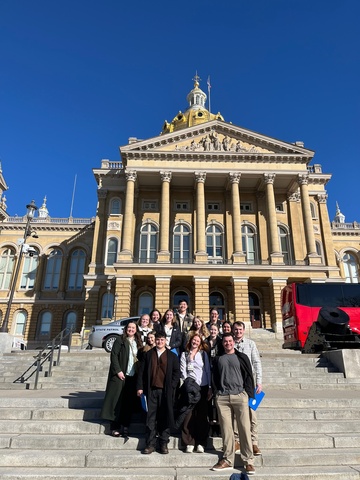
The culminating projects completed by DNP students often focus on affecting change on a clinical problem, but students can also focus, like Rene did, on health policy changes. Mary Dirks (09DNP, 97MSN, 88BSN), clinical professor, regularly mentors DNP students, many of whom are part of a years-long, scaffolded project to pass a bill through the Iowa legislature implementing an ARNP preceptor tax credit.
“Once they start getting involved in it, they get excited and have an interest in continuing,” says Dirks. “They are enthusiastic about health policy and the changes that can be made, and how that can affect access to care and patient outcomes.” Recent graduates Kate Pace (25DNP) and Kelcie Gunderson (25DNP, 21BSN) are still involved in the legislation project and told Dirks they want to see it through and have been ‘bitten by the bug.’
Buenzow, too, has been bitten by the policy bug and continues to work on health policy issues in Wisconsin. Without the UI DNP program, “I don’t think I would have had the knowledge base and full understanding of the implications of being involved at this level and what it does, not only for nurse practitioners, but all nurses,” she says. “It gave me a wider lens of how important it is that we stay abreast on policy because it affects our day-to-day livelihood, it affects how we care for patients, and it affects organizational structure of our workplaces. Nurses really need to have a seat at the table, and that includes in the legislative decision making processes.”
Crawford agrees and hopes that, as more and more DNPs graduate, nurse practitioners will have a broader footprint across policy and advocacy, bringing their unique understanding, knowledge and experience to the forefront. “Nurse practitioners are nurses first. We’re the ones who have taken care of patients at the bedside when they are sick in the hospital, walked with them through their chronic diseases and celebrated their victories. As nurses, that lens really matters when it comes to conversations around health policy, because not only do we understand the system we practice in and its challenges, we also understand the experience of patients.”
Crawford continues, “The more that we can leverage the DNP at the local, state, and national level, not just as practitioners who provide great health care, but also people who are deeply engaged in the policy conversation and shaping policy, the better off it is, not just for our profession, but for the population.”
Advocacy in Action
One of the most pressing challenges in nursing education in Iowa is finding preceptors, especially for advanced practice students.
In 2019, the Iowa Board of Nursing ARNP Advisory Board began studying the issue and decided to pursue implementation of an ARNP preceptor tax credit as an incentive.
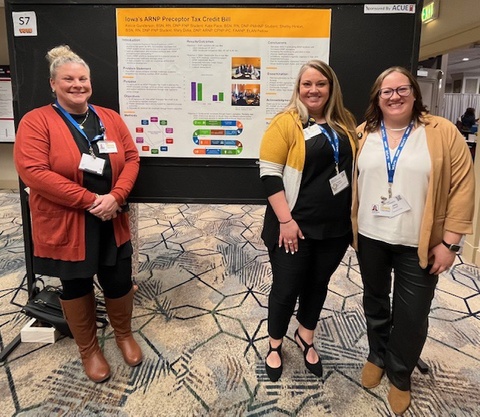
Working with a DNP student, they introduced a bill to the Iowa legislature in 2022.
The legislation has consistently received support among lawmakers, says Mary Dirks (09DNP, 97MSN, 88BSN), clinical professor, but tax bills are often set aside until the end, and legislative session time runs out.
Dirks has developed the legislation work into a scaffolded DNP project for students interested in health policy.
“Because it takes two years for their project, we decided to layer first- and second-year students,” she says. “The students mentor each other, share information, and work as a team to develop strategy throughout the year, but they each have to take a distinct leadership role and have their own purpose and objectives for their piece of the project.”