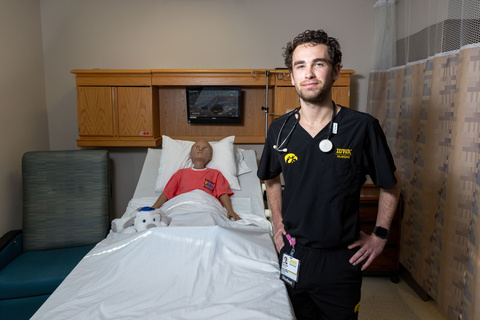
In late-September, after an endless battery of blood tests and injections, University of Iowa College of Nursing Bachelor of Science in Nursing (BSN) student Grayson Wills took a three-day trip to Chicago for a medical procedure. Six hours after sitting down at City of Hope Cancer Center, it was over.
“They took blood from one arm, spun it in a machine to separate the different blood products, and then they gave me back my blood,” says Wills. “The only thing I lost that day was my stem cells, which I already had a really high count of.” The next day he returned to Iowa while his stem cells traveled to Canada to be transplanted into the body of a 47-year-old man battling cancer. Wills is a registered donor with the National Marrow Donor Program and, although he will never meet the beneficiary of his stem cell donation, he would do it again in a heartbeat.
The first time Wills swabbed his cheek and sent it off to the registry that matches potential stem cell donors with recipients, things were very different. He was 12, and the patient needing the stem cell transplant was his twin brother, Calder, who was fighting T-cell Lymphoma. The whole family tested, but no one was a match and no donor was found through the registry. Calder passed away in November 2017.
Wills, an Iowa City, Iowa, native, always knew his future would be in healthcare. He chose nursing because, “ultimately, nurses have the greatest impact. I could see that with my brother,” he says. “I think nursing gives you that sense of love for the patient. To have people come in at their absolute worst and take the journey with them was something super important to me. We still get dinner with some of the nurses that [my brother] had who still work on the same floor.”
Before graduating from Iowa City’s City High School, Wills visited numerous nursing schools to find the right fit. When he walked through the doors of the College of Nursing, “it just felt right.” Nowhere he had visited felt as welcoming as Iowa.
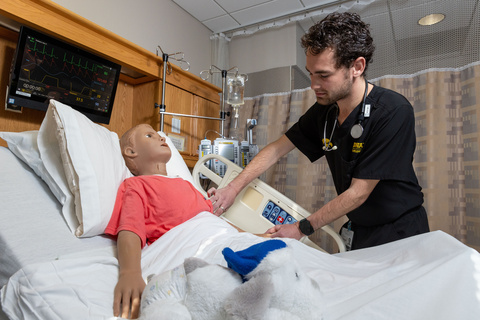
With one semester of clinical coursework under his belt, Wills is impressed by the support and encouragement of his professors. They not only make sure he and his cohort understand the material, but also “check in on us, and work with us and make sure that we're saying positive things about ourselves,” he says. As direct admission students, “we know we want to be nurses, but sometimes there's a little bit of doubt because it is so difficult or you just can't quite grasp the concept. Our professors have always been there to make sure that we know we can do it and that we made the right decision.”
Wills is keeping an open mind about exactly what he would like to do in the future. He has figured out he doesn’t gravitate to one particular patient population, he “just likes people”, which makes it difficult to choose a specialty. What he is sure about, however, is the importance of blood donation and the stem cell donor registry.
Wills long ago surpassed his goal to give back the same number of units of blood that his brother used during treatment, and today he is driven by a sense of fairness. The thought of the lack of blood causing “someone not being able to say goodbye to their loved one, or someone not being able to have another shot at life just doesn't seem so fair,” he says. “I feel like it's one of the small things that I can still provide society with. Even if all else fails, I'll still be able to give my blood products.”
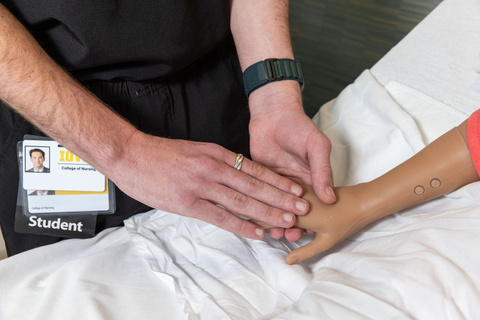
Wills speaks of stem cell donation and the donor registry with a similar passion. “The number of people who need bone marrow transplants or stem cells is astronomical. It's hard knowing that some of these people have matches, but you wouldn't know because they're not on the registry,” he says. He emphasizes the ease of his donation experience, noting that everything was paid for and he was compensated for missing work and school. “The only thing I had to do was get a few injections, make sure I was healthy, and sit there for a couple of hours and donate some products. It does not get much easier than that.”
Wills hopes that sharing his story will encourage others to join the registry. “The more people who join it, the more lives we can save,” he says. “And that's ultimately the most important thing.”

- Interested in joining the stem cell donor registry? Visit the National Marrow Donor Program to learn how.
- Find a blood drive near you at redcrossblood.org.
- On campus? Visit the DeGowan Blood Center and make a donation.